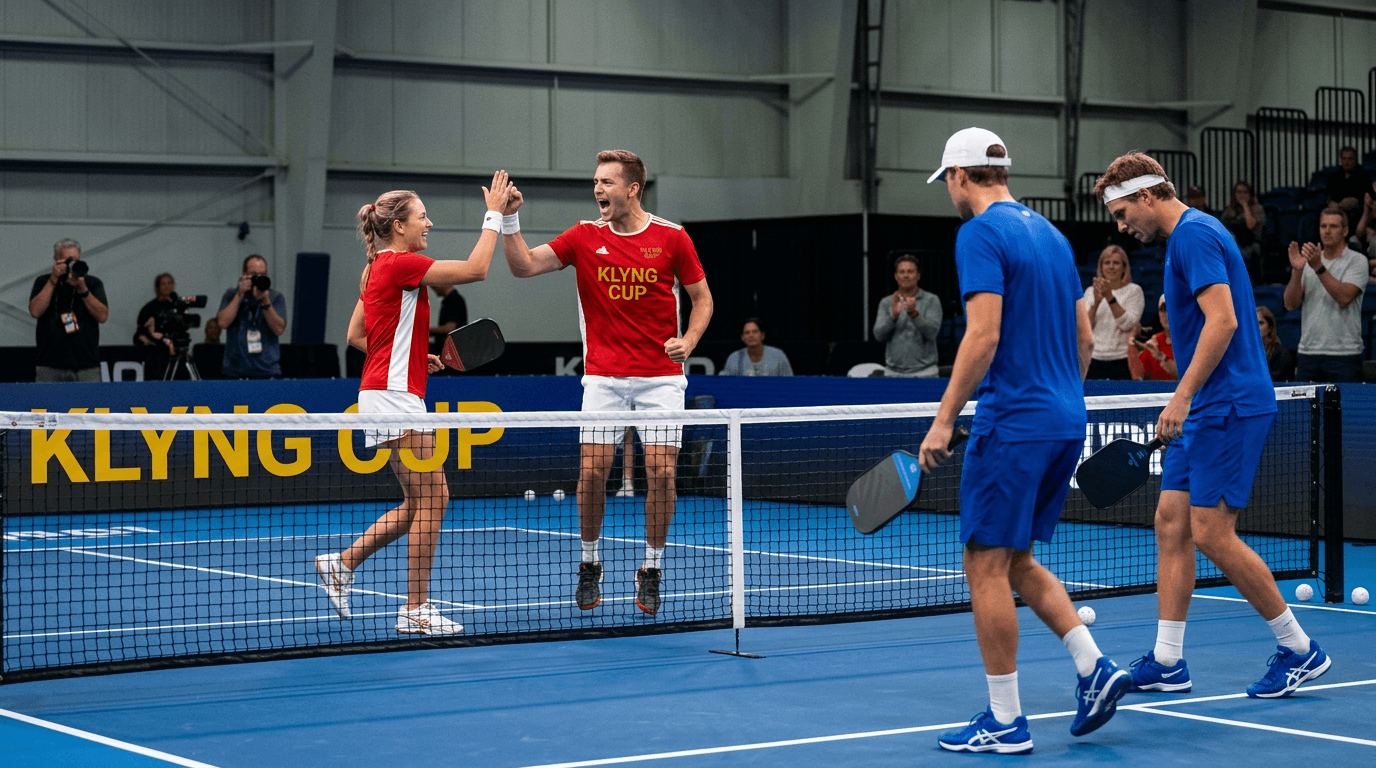
What Is the Klyng Cup Format? A Complete Guide to Canada's Inter-Club Pickleball League
If you've heard players talking about Klyng Cup — or if you keep seeing it come up when you search for Canadian pickleball tournaments — and you're not entirely sure what it is, this is the article for you.
Klyng Cup is not a single tournament. It's not a standard bracket event. It's an inter-club pickleball league with a team format unlike anything else in the Canadian pickleball landscape.
Here's everything you need to know.
The Basic Concept
Klyng Cup is club-versus-club team pickleball. Clubs from across Canada compete against each other in a format built around team performance rather than individual results.
Think of it like the Ryder Cup in golf, or a team relay in swimming. Your individual performance matters — but only as far as it contributes to your team's result. Win your match, and you earn points for your club. Lose, and your club absorbs the loss.
At the end of each season, club standings reflect the cumulative performance of every player on every roster across every tournament stop. The club at the top didn't just show up and get lucky — they built depth across skill levels, managed rosters intelligently, and competed over multiple events throughout the season.
The Match Format
A single Klyng Cup team matchup consists of four games, played in sequence:
Game 1 — Men's Doubles
Two male-identifying players from each club compete. First to 11, win by 2. Standard pickleball scoring.
Game 2 — Women's Doubles
Two female-identifying players from each club compete. Same scoring format.
Game 3 — Mixed Doubles 1
One male and one female player from each club. Captains set lineups before the game begins.
Game 4 — Mixed Doubles 2
A second mixed doubles pairing from each club. Different players than Mixed 1 — captains cannot reuse the same pairing.
After four games, whoever has won more games wins the match. If it's 3-1 or 4-0, the winner is clear. If it's 2-2, you go to the tiebreaker.
The Sudden Death Tiebreaker
When two clubs split the four games evenly at 2-2, the match comes down to one sudden death game.
All four players from each side participate — both doubles pairs on the court simultaneously for a mixed format game. The game is played to 11, win by 2.
The twist: captains must rotate their player lineup every 4 points. This means every player on the roster contributes to the tiebreaker result. You can't just put your two best players out there and ride them to the finish.
The tiebreaker is genuinely tense. The 2-2 score means both clubs are evenly matched. The rotation rule means strategy matters as much as individual skill. It's the best few minutes in competitive recreational pickleball.
The Captain's Role
Every Klyng Cup team is managed by a captain. The captain's job spans the whole event — before, during, and after each match.
Before the stop: Captains submit their lineups through the Klyng Cup Captain Portal before the deadline. The portal is mobile-first and requires no account login — captains access it via a unique link sent to them directly. They assign players to brackets, set matchup pairings, and confirm roster availability.
During the event: Captains enter live scores through the portal as each game finishes. Standings update automatically. The tournament director sees everything in real time without having to chase down results.
After the stop: Results are automatically submitted to DUPR within 24 hours. Club standings update across the season-long leaderboard.
Multi-Stop Seasons
Klyng Cup doesn't operate as a single-day tournament. Each season spans multiple stops — individual event dates — with standings aggregating across all of them.
A typical Klyng Cup season might include four to six stops spread across several months. Your club competes at as many stops as it chooses to enter. Points from each stop accumulate in the overall standings.
This format creates something individual tournaments can't: a season-long narrative. The club that led after Stop 1 might be overtaken by Stop 3. A club that had a rough start might surge at the end of the season. Rivalries develop between clubs that keep meeting in the standings. Players know their results have consequences that stretch beyond a single weekend.
Three seasons run annually — Spring, Summer, and Fall. Each season has its own champion.
Skill Brackets
Not every player competes against every other player. Klyng Cup events are divided into skill brackets based on DUPR ratings — typically ranging from 3.0 through 4.5 and above.
Each bracket maintains its own standings. Your club's overall standing reflects cumulative performance across all brackets — which means depth matters. A club with strong 3.5 players and weaker 4.5 players can still compete with a club whose roster is loaded at 4.5, if they dominate the lower brackets.
This makes Klyng Cup genuinely inclusive. There's a competitive home for players at every level, and every player's contribution matters to the team's overall result.
How Points Work
Klyng Cup uses a straightforward points system:
- Match win: 3 points for the club
- Match loss: 1 point for the club (showing up counts)
- Forfeit: 0 points
The tiebreaker result determines who gets the 3-point win. No team ever earns zero from a match they competed in — the 1-point consolation for a loss is intentional. It encourages participation and rewards showing up even on a tough day.
Standings are ranked by total points, with slot points (total game wins) and score differential used as tiebreakers.
How to Compete
As a player: Create a free profile at klyngcup.com. Find a tournament near you and register. If your club is already on the platform, you'll join their roster. If you don't have a home club, join the Wildcard Pool and get drafted.
As a club director: The Klyng Cup format runs on Klyng OS — the tournament operating system that powers the entire platform. Directors can set up their club, configure brackets, and run their first Klyng Cup event in under 15 minutes. Visit klyngos.com to start a free 30-day trial.
The format is the best team competition in recreational pickleball. Come find out why 50+ Canadian clubs are playing it.
Klyng Cup Team
klyngcup.com